
1885 - 1916

CPL David Wallace Crawford
1887 - 1916

Lce-Corpl John Joseph Nickle
1894 - 1916

Pte 17911 Morton Neill
1897 - 1916

Lieut Edward Stanley Ashcroft
1883 - 1918

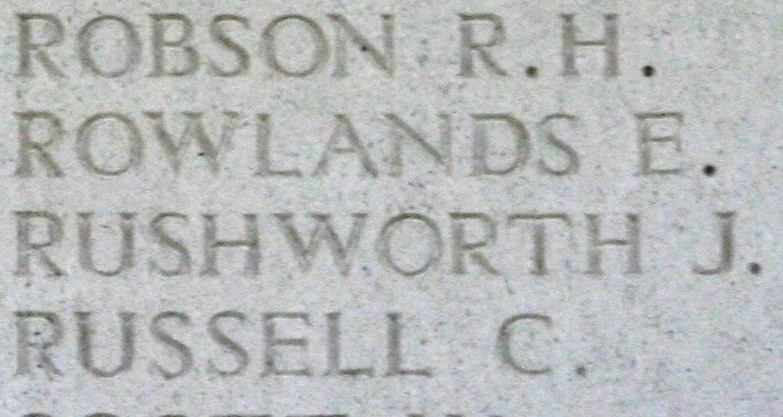
Private 332401 Robert Hollis Robson
- Age: 34
- From: Liverpool
- Regiment: 13th Kings
- Died on Thursday 28th March 1918
- Commemorated at: Arras Memorial
Panel Ref: Bay 3
Robert Hollis Robson was born Robert Hollis in Toxteth Park, Liverpool, in 1883. It is not known who his parents were. The Hollis family came from Draycott in Staffordshire, and at least two of his aunts settled in the Liverpool area.
In 1891 “Rob Hollis”, age 7, is living with his aunt, Elizabeth Adams (née Hollis), 40, and her eight children at 153 Wellington Road.
Robert has not been found on the 1901 census, nor on crew lists. A Robert Hollis, age given as 19, and birthplace Liverpool, is employed as a servant/dairyman with the Pollard family in Tagus Street, Toxteth Park. However, there is no birth record for a Robert Hollis of this age, so this is possibly Robert (he would have been 17).
By 1911 he is living with another aunt, Caroline Robson (née Hollis), her husband Henry Robson, and five children at 115 Rosebery Street, Toxteth Park. “Robert Hollen” (transcription error) is 27, employed as a cotton porter.
He evidently considered Henry and Caroline his adoptive parents and took the last name Robson. When he was 32, “Robert Hollis Robson” married Isabel Jones on 26th March 1916 in St. Mathew’s Church, Bootle, giving his address as 171 Worcester Road, Bootle, and his occupation as cotton porter. He gives his father as Harry Robson, also a cotton porter (the husband of his aunt Caroline who, in 1911 was a lift attendant, but on later records is found as a cotton porter).
He enlisted in Liverpool, and served as Private 332401, Robert Hollis Robson, 20th (Pals) Battalion.of The King’s Liverpool Regiment. The amount of the War Gratuity suggests that he served for two years, enlisting or being conscripted in about April 1916, shortly after he married. No records of children born to the marriage have been found.
At some point he was posted to the 13th Battalionn K.L.R. Whether with the 20th or the 13th Bn., Robert would have seen action in the later stages of the Battle of the Somme, at Arras in 1917, and Third Ypres (Passchendaele) later that year.
Robert was declared Missing on 28th March 1918, and his death later assumed, for official purposes, as having occurred on that date. His body was never recovered from the battlefield, or was subsequently lost, and he is commemorated on the Arras Memorial to the Missing.
The ARRAS MEMORIAL commemorates almost 35,000 servicemen from the United Kingdom, South Africa and New Zealand who died in the Arras sector between the spring of 1916 and 7 August 1918, the eve of the Advance to Victory, and have no known grave. The most conspicuous events of this period were the Arras offensive of April-May 1917, and the German attack in the spring of 1918. Canadian and Australian servicemen killed in these operations are commemorated by memorials at Vimy and Villers-Bretonneux. A separate memorial remembers those killed in the Battle of Cambrai in 1917. Both cemetery and memorial were designed by Sir Edwin Lutyens, with sculpture by Sir William Reid Dick. The memorial was unveiled by Lord Trenchard, Marshal of the Royal Air Force on the 31 July 1932 (originally it had been scheduled for 15 May, but due to the sudden death of French President Doumer, as a mark of respect, the ceremony was postponed until July).
The pension card (giving his battalion as 9th King’s) shows that his wife Elizabeth [sic] Robson, at 51 Saxony Road, Kensington, Liverpool, was awarded a pension of 13/9d a week from December 1918. Isabel received his Army effects and a War Gratuity of £11.
His medal roll shows only service in the 20th and 13th Battalions of The King's Liverpool Regiment.
In 1939 Isabel, 56, is still living at 51 Saxony Road, with Arthur Jones (a possible relative). Isabel never remarried, and died in 1967, aged 85, still living in Saxony Road.
His adoptive parents, Henry Robson died in 1924, and his aunt Caroline in 1944.
Robert is remembered on 9th Kings.co.uk website.
We currently have no further information on Robert Hollis Robson, If you have or know someone who may be able to add to the history of this soldier, please contact us.
Killed On This Day.
(108 Years this day)Tuesday 30th April 1918.
L/Cpl 29203 Valentine Alexander
26 years old
(108 Years this day)
Tuesday 30th April 1918.
Pte 27948 Joseph Atherton
26 years old
(108 Years this day)
Tuesday 30th April 1918.
Pte 51896 Richard Edward Banks
34 years old
(108 Years this day)
Tuesday 30th April 1918.
Pte 46630 Watson Bell
38 years old
(108 Years this day)
Tuesday 30th April 1918.
Lieut Roland Henry Brewerton
27 years old
(108 Years this day)
Tuesday 30th April 1918.
Pte 51708 Charles Norman Dod
21 years old
(108 Years this day)
Tuesday 30th April 1918.
L/Cpl 94246 Frank Emison
24 years old
(108 Years this day)
Tuesday 30th April 1918.
Pte 23056 John William Jones
27 years old
(108 Years this day)
Tuesday 30th April 1918.
Pte 49572 John Henry Leadbeater (MM)
27 years old
(108 Years this day)
Tuesday 30th April 1918.
Sgt 22462 James Lowe (MID)
25 years old
(108 Years this day)
Tuesday 30th April 1918.
Pte 51712 Edgar Domenico Murray
21 years old
(108 Years this day)
Tuesday 30th April 1918.
Pte 269899 Harry Pitts
21 years old
A total of 14 Pals were killed on this day. View All